April 7, 2011

Colombian - U.S. Trade Deal: Downsides?

The United States is getting closer to a trade deal with the country of Colombia. I was born in Colombia, and have been following these developments for some time. President Obama and Colombian President Juan Manuel Santos, are giving a press conference today to discuss the recent advances in negotiations. As I thought about this, my initial reaction was that it was a good thing for the United States. I found it interesting that the US Chamber of Commerce President Donahue, to come out praising Obama for the events. Donahue was a man ademently opposed to Obama during his presidential run. He donated and raised a lot of money to support elections, mostly for the Republican side. This fact alone made me wonder, whether this trade deal was a good thing. Who specifically was going to be effected when it passes?
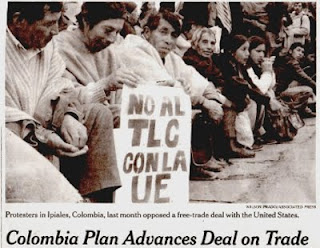
As I read an article in the NY times about it, I saw a photo of farmers from Ipialis, Colombia protesting, coming together holding signs denouncing the deal. It dawned on me that as part of the trade deal, industrial and Agricultural goods would have duties lifted immediately and the other 20% would be phased out over 10 years. This means Colombian companies and government agencies would be paying less for importing goods from the US (since no custom duty taxes/fees will be added)and could potentially use the savings to buy even more goods from US companies. This sounds like a boon for US companies, and it might be. However what I realized as I stared at those farmers in the NY times Photograph, was the effect on them. Their Agricultural products would now be competing with imports from the US which have become cheaper to acquire if the trade agreement goes through (which it mostly likely will as Republicans have been pushing for it for sometime). To compete, these farmers would need to drop their prices and as a result, incomes for them, drop. If many of these farmers are already impoverished, barely making enough working on the farm to get by, the developments of a trade deal may be devastating financially for them. This has fueled reason for protests against the deal, protest which are being organized and conducted in Colombia itself.


It seems as if this is what has been done in a sense to the average American worker, also effected by the effects of globalization and free trade. As Companies shipped jobs overseas and outsourced many functions to countries paying less then wages expected by Americans, their job security and feeling of optimism for a bright future, soon dimmed. Now what we have is a case of companies flush with cash from the ability to borrow at such low rates, can now begin to push some of that cash into the economy by hiring and expanding. HOWEVER, although this seems like a good thing and the path to recovery, many of these companies hire back these same workers at a fraction of the wage/salary previously made.

For example, General Motors and the United Auto Workers changed a provision in their labor contract allowing workers to start at $14 vs. the $28 per hour before the provision was changed. That is a 50% drop!!! Just like the farmers in Colombia who now are faced with having to drop their prices substantially to compete with American Companies, Workers in America have dropped wages, as they compete with other job seekers here and across the world, for the same positions. As the Colombian Economy may very well eventually grow through increased trade, the local farmers may be the ones shouldering the burdens that might result from a trade deal.

April 1, 2011

American Support in Libya

Libyans Supporting US and NATO Military action in Libya, march in a Rebel held city in celebration, after near defeat by Qaddafi's forces. I found this picture especially interesting because for most of my life, the media has always broadcasted images of Arabs defaming the American flag, burning it, or jumping on it in a sign of disrespect. Now for the first time, I see Arabs supporting the US and waving its flag in the air. Although the U.S. and it's track record in history has been far from perfect, America has always been a work in progress. It has shifted back in forth between the bully of the world, and the preserver of human rights. Although the intervention will likely prolong this conflict, it's good to see images showing other parts of the world who respect, and look up to the United States. The U.S. has responsibility to lead in a morale way.

March 31, 2011

America 19th Century

America 19th Century
The Nascent American economy of the 19th century moved forward for this relatively new but determined nation. Transportation networks created to facilitate trade and travel, expanded the economy and caused commerce to grow. Americans wanted to get from place to place rapidly and cheaply. As spending on transportation infrastructure spurred development, The economic development of the United States continued growing, largely helped by the system river networks. Commerce was able flow from the farms to the ports and coastal areas allowing farmers to grow what was profitable and could be traded. Farmers had a larger market now and took out larger loans to finance their expanded farming operations. Bankers and creditors began to find themselves full of customers, needing finance to expand their operations. The added circulation of money, increased the growth of the economy even further. Bankers reaped profits while farmers increased production and supplied the markets with goods.


In the 19th Century, the use flatboats and emergence of steamboats revolutionized the distribution of goods. The steamboat made traveling upstream possible (something not often seen before that) and greatly enhanced how people and goods were transported back and forth along rivers. The Ohio-Mississippi river had a system which made possible access to agricultural areas where crops, staples, or commodities could regularly be loaded and transported across much of the country. The steamboat revolutionized the commerce capabilities of the new America and the added benefit of upriver navigation, only created more demand to travel the rivers. Costs of transporting goods were reduced using the network of water ways and the speed which goods were transported, allowed flourishing two-way commerce on the Ohio and Mississippi rivers.


America in 19th century fashion, built a system of canals intricately linking the seaboard cities to the Midwestern states also allowing for an efficient and stable system for shipping western farm products directly to the growing urban markets of the seaboard states. Commerce flowed more freely and did so at reduced rates. Along with the River Networks, the investment and expansion of railroads, also increased the capacity to trade at cost effective rates to move goods across the nation by land. The combination of expanded trade by land and sea, created a sense of opportunity, causing some investors and entrepreneurs to join the market that was filled with new technologies and real possibilities. The expansion of trade contributed to the economy and new means of transportation heralded a new era of commerce and economic expansion for a young nation whose economy was growing. Investing in transportation networks where beginning to pay off. As the economy grew, so did American's Standard of Living for many Americans.

March 30, 2011

Effects of the Great Depression

The effects of the Great Depression took its toll on the health and welfare of the United States. Systematic bank failures, a credit crunch, and a crashing stock market, all contributed to the fall from a standard of living that millions of Americans had taken for granted. Unemployment hit over 25% as factories and industry cut back on production. Falling stock prices throughout the decade, had already put pressure on Farmers profit margins. With shuttered businesses, crop prices fell even more throughout the Great Depression, forcing many farms into foreclosure. As Credit became scarce, Businesses were not able to raise capital for expansion. Mass lay offs both in the private and public sector, left the Majority of American people, bewildered and confused. Roughly 1 in 4 Americans lost their entire life savings. Poverty rose as many Americans found themselves standing in long breadlines to get a meal. Many owners of automobiles, could not afford gas and would pull them using mules. These were named after the President, known as "Hoover Wagons.


Americans Who Benefited


The Great Depression period also included Americans who profited greatly from the stock market collapse and economic turmoil. Men like Bernard Baruch would "short" the market, increasing the value of their position as the market fell. The duration and severity of the Stock Market fall during 1929-1932 created opportunities for a market operator to take a position short selling. Jesse Livermore was said to be worth $100 million dollars after the market crashed in 1929. The President during the great depression was Herbert Hoover. Americans wanted to see results, accountability, and opportunity again. President Hoover pressed for an inquiry into the short selling as a cause of the market fall. In the end, it turned out to be much more complex than just heavy short selling. The fall also was a result of bank issues securities that ended up being worthless. This over leveraging of the market, was the ingredient necessary to have such a steep sell off that resulted in the great market decline. The effects of the Great Depression lasted for years on families.

President Hoover had adamantly spoken out against poverty in his inauguration speech, and know his name was becoming synonymous with it. As the market bottomed out, new leadership was assembling in Washington on March 4th, 1932 - President Franklin D. Roosevelt's Inauguration day. The real life Effects of the Great Depression left millions of Americans feeling so despondent and desperate, they were deeply and psychologically in need of a leader that could breath life back into their souls. They were willing to work hard to bring the U.S. back to prominence, they just needed to believe. As Roosevelt was sworn in, the country held its breath, listening to a new leader take charge.

March 28, 2011

Forecasting Stock Market Movements

The stock market has been described before as a game of numbers. Prices of stocks and commodities fluctuate based on supply and demand. If a drought destroy acres and acres of wheat, that is less wheat that will go onto the market. If the effect is large enough, investors may begin to buy wheat futures anticipating the rising wheat prices from future demand and lower supply. This is true for stocks as well. If some news or event impacts the mindset of stock holders of a particular company, collectively their actions could be enough to drive the stock in a certain direction. Some investors may believe the rise in wheat prices will mean a potential squeeze on restaurant's profits, due to higher cost of supplies for wheat, flour, grains, etc.. This could result in restaurant stocks being sold off and the prices falling. The smart money managers want to be ahead of the curve. They want to operate in the future based on their analysis and judgment of an investing move. Some may even watch for the fall of these type of stocks and decide they may look like a good short sale. Whichever direction these stocks move and the trades go, there are only three possible directions: Up, Down, and Horizontal. That means stocks will be moving in those directions at some point. Trying to locate a cycle or pattern is important in seeing the whether rises are upward trends, or simply an upward movement of a stock trading in a range.